Big data often tells us that two things are related without explaining the underlying cause. For example, data once revealed that orange cars were half as likely to have defects; while the reason was unclear, the correlation alone was valuable for predicting vehicle reliability. Transformation Across Key Sectors
In their seminal book, , Viktor Mayer-Schönberger and Kenneth Cukier argue that we are witnessing a fundamental shift in how society processes information. Rather than focusing on "small data" through precise sampling, the "Big Data" revolution embraces messier, massive datasets to uncover correlations that were previously invisible. This transformation is moving us away from asking why something happens to focusing on what is happening, allowing for powerful predictions across every sector of human life. The Three Pillars of the Big Data Shift
Traditional statistics rely on small samples to represent a whole. Big data allows us to analyze nearly every data point in a set, which eliminates sampling errors and lets us "zoom in" on small subgroups without losing reliability.
Despite the benefits, Mayer-Schönberger and Cukier warn of a "dark side":
Using VerbAce-Pro
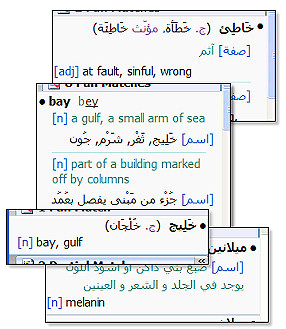
To use VerbAce-Pro just click on the word you want to translate, and the VerbAce-Pro results window will pop up with the trasnslation you need.
VerbAce-Pro captures and translates words and phrases from most Windows applications.
You can also pass the mouse over words and obtain quick translation via the Micro Window, or search for words by typing them in the term box.
Dictionary Features
|
Arabic broken plural and feminine forms | |
|
English usage indications | |
|
English broken plural forms | |
|
Entries sub-meanings (when applicable) | |
|
Many technical fields covered (Medicine, Anatomy, Law, Computing, Finance, and more) |
Advanced Morphological Engine
VerbAce-Pro morphological engine can analyze complex word formations and display the relevant dictionary entries.
The engine also detects and shows the form number of Arabic verbs.
Big data often tells us that two things are related without explaining the underlying cause. For example, data once revealed that orange cars were half as likely to have defects; while the reason was unclear, the correlation alone was valuable for predicting vehicle reliability. Transformation Across Key Sectors
In their seminal book, , Viktor Mayer-Schönberger and Kenneth Cukier argue that we are witnessing a fundamental shift in how society processes information. Rather than focusing on "small data" through precise sampling, the "Big Data" revolution embraces messier, massive datasets to uncover correlations that were previously invisible. This transformation is moving us away from asking why something happens to focusing on what is happening, allowing for powerful predictions across every sector of human life. The Three Pillars of the Big Data Shift Big Data: How the Information Revolution Is Tra...
Traditional statistics rely on small samples to represent a whole. Big data allows us to analyze nearly every data point in a set, which eliminates sampling errors and lets us "zoom in" on small subgroups without losing reliability. Big data often tells us that two things
Despite the benefits, Mayer-Schönberger and Cukier warn of a "dark side": Rather than focusing on "small data" through precise
Made with Mobirise web themes